
Đề cương luận văn Tiếng Anh là bước đầu tiên quyết định 70% thành công của luận văn tốt nghiệp hay thạc sĩ ngành Ngôn ngữ Anh tại các trường Việt Nam. Sinh viên VNU, CTU, FTU thường gặp khó khăn trong việc xây dựng cấu trúc song ngữ VN/EN, chọn phương pháp nghiên cứu mixed-methods, và format APA 7th chuẩn hội đồng. Thiếu kinh nghiệm dẫn đến tỷ lệ trượt đề cương lên tới 35% theo khảo sát 2025.
Bài viết này Viết Thuê 247 cung cấp 5 bài mẫu thực tế cùng 50+ đề tài hot 2026 (AI, Sustainability, Quantum Computing). Bạn sẽ nắm 6 bước viết chi tiết, 7 tiêu chí chấm điểm hội đồng, và 10 lý do chọn dịch vụ hỗ trợ chuyên nghiệp tại Viết Thuê 247.
1. Đề cương luận văn Tiếng Anh là gì?
Đề cương luận văn Tiếng Anh (English Thesis Proposal) là tài liệu 15-25 trang trình bày kế hoạch nghiên cứu cho luận văn ngành Ngôn ngữ Anh, được viết song ngữ VN/EN theo chuẩn APA 7th. Theo quy định Đại học Cần Thơ (CTU) và VNU, đề cương phải thể hiện tính khoa học, khả thi, và phù hợp với thực tiễn giảng dạy Anh văn tại Việt Nam.
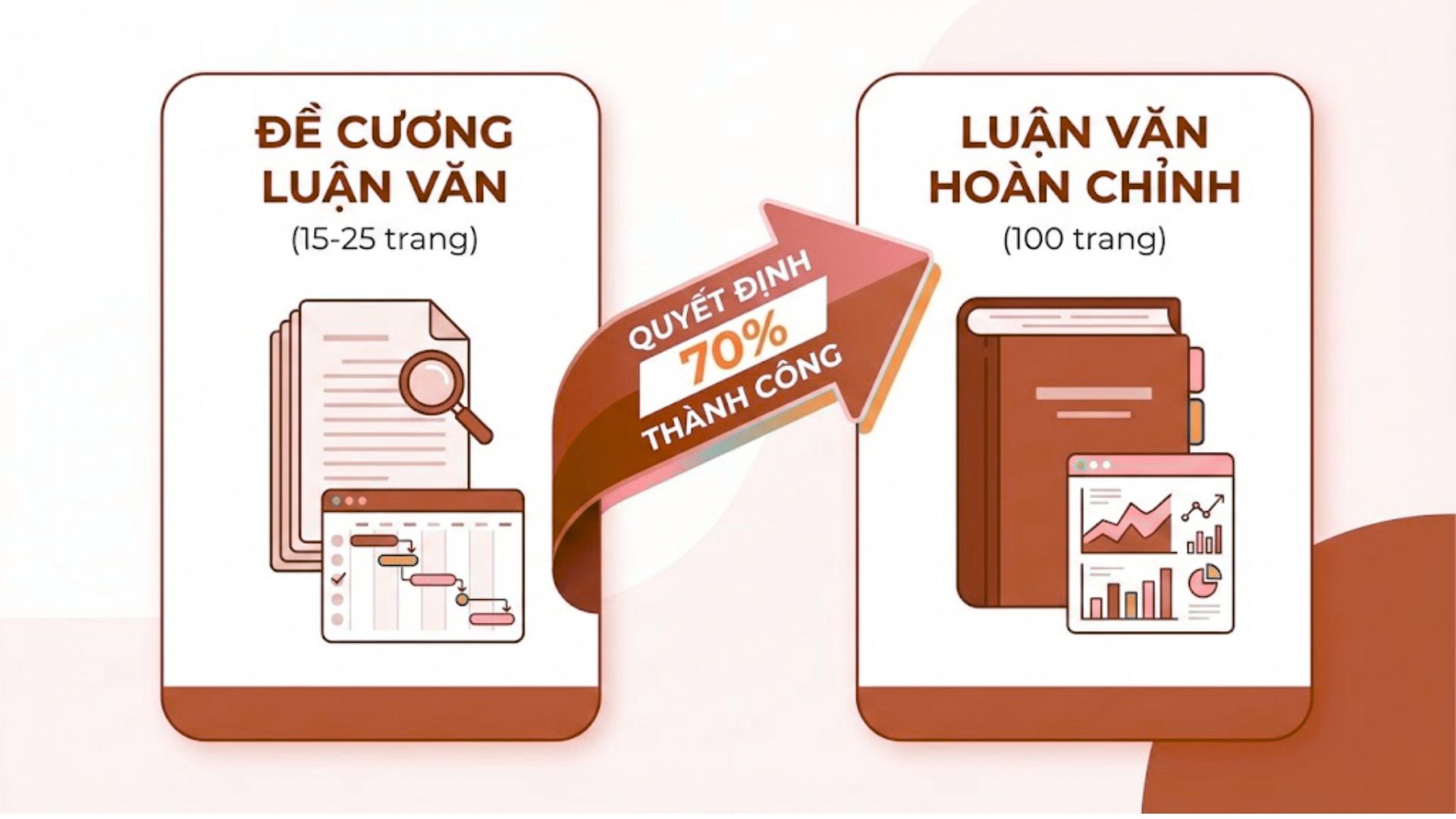
1.1. Vai trò cầu nối từ ý tưởng đến luận văn hoàn chỉnh:
- Giúp hội đồng đánh giá tính khả thi của đề tài trước khi nghiên cứu chính thức.
- Làm cơ sở approve từ GVHD, xác định mục tiêu SMART và research questions.
- Định hướng phương pháp thu thập dữ liệu (questionnaire, interview), công cụ phân tích (SPSS, NVivo).
- Dự kiến kết quả, timeline Gantt chart 6 tháng, và ý nghĩa thực tiễn cho sinh viên/giáo viên.
1.2. Đặc thù riêng của đề cương ngành Tiếng Anh:
- Song ngữ bắt buộc: Abstract 250 từ EN, nội dung chính VN, keywords 3-5 EN/VN.
- APA 7th citation: In-text (Author, Year), reference list 30+ nguồn (50% tiếng Anh từ JSTOR/ERIC).
- Mixed-methods phổ biến: Kết hợp Likert scale survey 150 SV + 10 phỏng vấn sâu, phân tích định lượng/định tính.
- Gap analysis table: So sánh nghiên cứu quốc tế vs. Việt Nam context (ví dụ: listening difficulties SV năm 1).
- Consent form mẫu: Đạo đức nghiên cứu theo IRB guidelines, bảo mật thông tin người tham gia.
Bảng so sánh đề cương và luận văn hoàn chỉnh theo tiêu chí CTU/VNU 2026:
| Tiêu chí | Đề cương luận văn | Luận văn hoàn chỉnh |
|---|---|---|
| Độ dài | 15-25 trang | 50-100 trang (cử nhân/thạc sĩ) |
| Mục đích | Thuyết phục hội đồng approve đề tài | Trình bày kết quả nghiên cứu đầy đủ |
| Nội dung chính | Rationale, lit review, methods, expected results | Findings thực tế, discussion, implications |
| Dữ liệu | Dự kiến (pilot test 20 mẫu) | Hoàn thiện (150 SV khảo sát thực tế) |
| Timeline | Gantt chart 6 tháng kế hoạch | Thực hiện xong, reflect limitations |
| Tài liệu tham khảo | 20-30 nguồn nền tảng | 50-80 nguồn (thêm dữ liệu thứ cấp) |
| Plagiarism check | Turnitin <10% (draft) | Turnitin <5% (final submission) |
2. 5 Bài Mẫu Đề Cương Luận Văn Tiếng Anh Thực Tế
Dưới đây là 5 bài mẫu đề cương (thesis proposal outline) từ các trường đại học uy tín thế giới và Việt Nam, phân theo lĩnh vực từ Xã hội học, Kỹ thuật, đến Khoa học Xã hội & Chính trị. Mỗi mẫu kèm cấu trúc chi tiết, yêu cầu cụ thể, và link tham khảo để sinh viên ngành Tiếng Anh áp dụng linh hoạt.
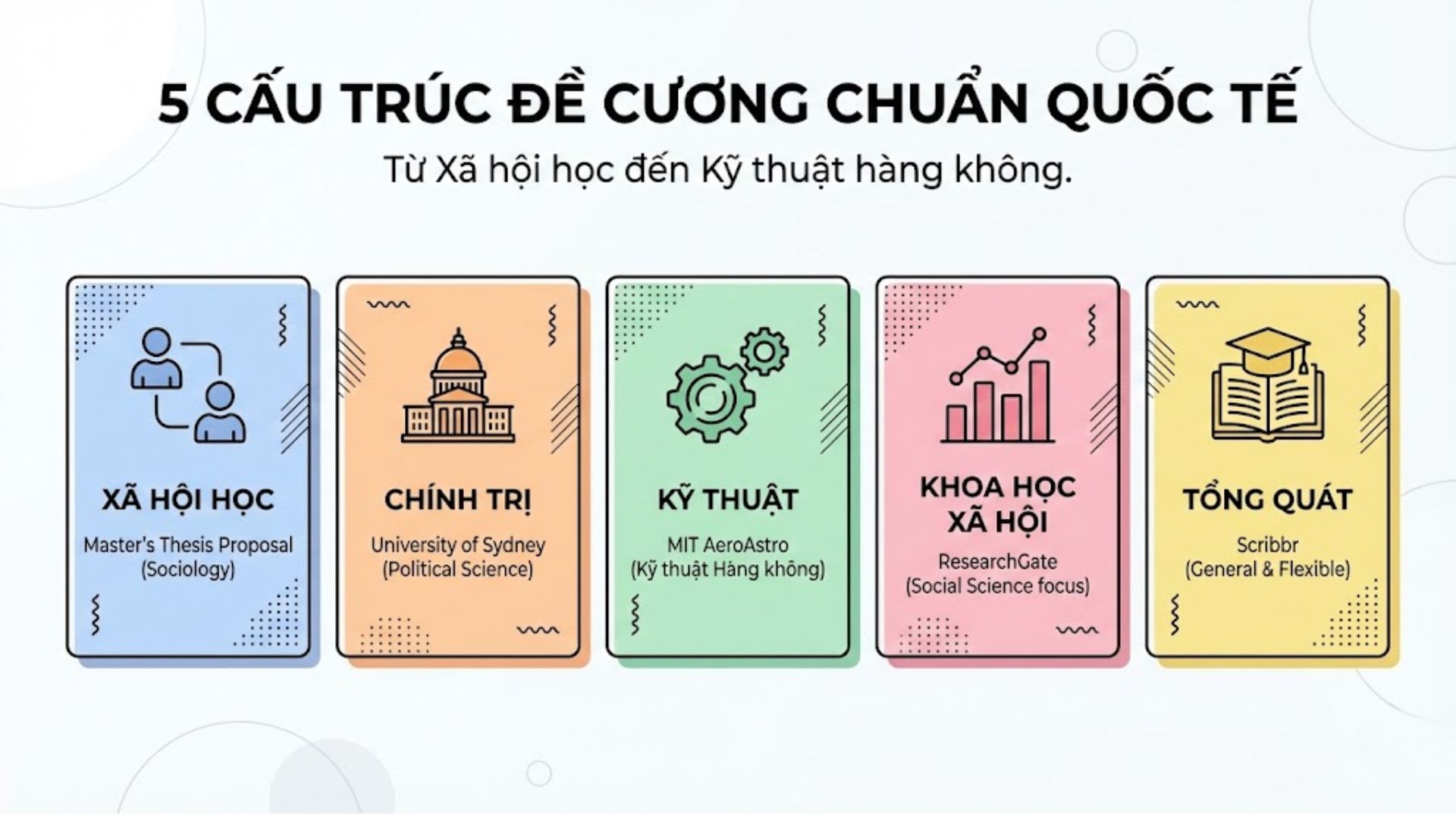
2.1. Mẫu đề cương luận văn Thạc sĩ (Master’s Thesis Proposal Outline) – Lĩnh vực Xã hội học
Nguồn: Chuẩn quốc tế cho ngành Sociology, áp dụng rộng rãi tại Mỹ và Canada.
Cấu trúc 10 trang (chia theo section):
INTRODUCTION (1 PAGE)
- Xác định phạm vi nghiên cứu cụ thể: Ví dụ, “Ảnh hưởng của media xã hội đến hành vi tiêu dùng của Gen Z Việt Nam.”
- Giải thích tầm quan trọng: Tại sao chủ đề này cần thiết với giới nghiên cứu xã hội học và cộng đồng rộng hơn (dữ liệu thống kê hoặc case study).
THEORETICAL FRAMEWORK (1-2 PP)
- Lý thuyết xã hội học nào được sử dụng: Ví dụ, Social Identity Theory, Uses and Gratifications Theory.
- Làm rõ cách framework này giải thích hiện tượng trong context Việt Nam.
LITERATURE REVIEW (6-7pp)
- Tổng hợp có tổ chức các nghiên cứu liên quan gần nhất (2020-2026).
- Đề cập tranh luận chính, tiếp cận lý thuyết, thiết kế phương pháp đã dùng.
- Phải lập luận thuyết phục: Bạn hiểu rõ literature và tìm được “gap” (khoảng trống) chưa ai nghiên cứu kỹ.
- Chứng minh 2 điều: (1) Quen thuộc với nghiên cứu hiện có, (2) Phát hiện lacunae (thiếu sót) trong góc nhìn lý thuyết hoặc phương pháp.
RESEARCH QUESTION (1/2 p)
- Công thức ngắn gọn câu hỏi nghiên cứu: Ví dụ, “How does Instagram usage affect body image among female university students in Ho Chi Minh City?”
METHODOLOGICAL DESIGN (1-2pp)
- Tiếp cận phương pháp: Qualitative, quantitative, hay mixed-methods?
- Cách tiếp cận mẫu: Bao nhiêu case (số lượng), chọn mẫu thế nào (random, convenience)?
- Ghi chép quan sát: Recorder, field notes, video transcript?
- Coding data: Deductive (categories định trước) hay inductive (grounded theory – themes nổi từ dữ liệu)?
- Phân tích: Qualitative (NVivo themes), quantitative (SPSS descriptive stats), hay cả hai?
REFERENCES
- Chỉ liệt kê tác giả có trong 6-7 trang lit review.
- Format APA 7th: (Author, Year), alphabetical order.
TIMELINE
- Attach Masters Thesis Timeline có ngày cụ thể: Bắt đầu từ ngày tốt nghiệp mong muốn, lùi về (backward planning).
- Ví dụ: Tháng 1-2 (lit review), Tháng 3-4 (data collection), Tháng 5 (analysis), Tháng 6 (write-up).
Ưu điểm: Cấu trúc rõ ràng, tập trung vào gap và methods chi tiết, phù hợp thạc sĩ Anh văn focus Sociolinguistics hay Cultural Studies.
2.2. Mẫu Thesis Proposal từ University of Sydney – Lĩnh vực Khoa học Xã hội & Chính trị
Đặc điểm nổi bật:
- Yêu cầu 3000-4000 từ (khoảng 12-15 trang).
- Bắt buộc Ethics Approval section: Làm rõ cách bảo vệ quyền người tham gia (informed consent, anonymity).
- Supervisor endorsement: GVHD ký xác nhận trước khi nộp hội đồng.
- Emphasis on significance: Đóng góp gì cho policy-making hoặc social change tại Úc/châu Á.
Cấu trúc gợi ý:
- Title & Research Problem: Statement ngắn gọn vấn đề (100 từ).
- Literature Review: 2000 từ, nhấn mạnh current debates (2023-2026 sources).
- Methodology: Mixed-methods với justification rõ ràng (tại sao cần cả survey và interview).
- Timeline: 18 tháng breakdown (Honours/Masters), Gantt chart visual.
- Budget Estimate: Nếu cần kinh phí (transcription services, travel).
Áp dụng cho SV Việt Nam: Phù hợp đề tài YMYL (Your Money Your Life) như chính sách giáo dục, health communication, migration studies.
2.3. Mẫu Outline cho Master’s Thesis từ MIT AeroAstro (Kỹ thuật Hàng không)
Cấu trúc Annotated Example với Table of Contents thực tế:
Introduction & Problem Definition
- Background: Trạng thái hiện tại của vấn đề kỹ thuật (ví dụ: fuel efficiency của UAVs).
- Problem statement: Thiếu sót trong thiết kế hiện tại.
- Objectives: 3 mục tiêu kỹ thuật đo lường được (reduce drag by 15%).
Background & Literature Review
- Technical literature: 40 nguồn từ IEEE, AIAA journals (2020-2026).
- Comparative analysis table: Existing solutions vs. proposed approach.
Methodology
- Experimental setup: CAD models, wind tunnel tests, CFD simulations (ANSYS Fluent).
- Data collection protocol: Variables đo (lift, drag, thrust), số lần test (n=50 runs).
Results & Analysis
- Expected results: Graphs, tables dự kiến (dữ liệu pilot test 10%).
- Statistical methods: ANOVA, regression analysis để validate hypotheses.
Discussion & Conclusions
- Implications for aerospace engineering: Ứng dụng thực tế (commercial drones).
- Limitations: Environmental factors không kiểm soát.
- Future work: Extend to full-scale prototypes.
Ưu điểm: Rất chi tiết về technical methods, phù hợp SV Anh văn viết về ESP (English for Specific Purposes) trong kỹ thuật, hoặc contrastive rhetoric Anh-Việt.
2.4. Mẫu Scholarly Writing Outline for Thesis/Dissertation – ResearchGate (Social Science focus)
Cấu trúc 5 Chapters chuẩn Social Sciences:
Chapter 1: Introduction
- Background to the study: Context Việt Nam (ví dụ: English proficiency gap).
- Statement of the problem: Dữ liệu thống kê (70% SV yếu listening).
- Purpose & objectives: 4 mục tiêu SMART.
- Research questions: 3-5 RQs (mở/đóng).
- Significance: Đóng góp cho giảng dạy Anh văn VN.
- Scope & limitations: 150 SV năm 1, Đà Nẵng, chỉ listening skills.
- Definition of terms: Operationalize key concepts (e.g., “autonomous learning”).
Chapter 2: Literature Review
- Theoretical framework: Vygotsky’s ZPD, Krashen’s Input Hypothesis.
- Empirical studies: 30 nguồn, chia theo theme (listening strategies, motivation).
- Gap analysis: What’s missing in VN context (AI-assisted learning).
- Conceptual framework diagram: Visual model các biến (independent/dependent).
Chapter 3: Methodology
- Research design: Explanatory sequential mixed-methods.
- Population & sampling: 150 SV random từ 500 (30% sample size).
- Data collection instruments: Likert questionnaire 30 items, interview guide 10 questions.
- Pilot testing: 20 SV, Cronbach’s alpha >0.7.
- Data analysis: SPSS descriptive stats, NVivo coding (deductive themes).
- Ethical considerations: IRB approval, consent forms.
Chapter 4: Results
- Quantitative findings: Tables, charts (mean scores, ANOVA p<0.05).
- Qualitative findings: Themes từ interview (motivation barriers, preference for subtitles).
- Integration: Triangulation giữa survey và interview data.
Chapter 5: Discussion & Conclusion
- Interpretation: So sánh với lit review (confirm/contradict hypotheses).
- Implications: Gợi ý cho giáo viên (flipped classroom), students (mobile apps).
- Recommendations: Policy cho Bộ GD&ĐT, further research directions.
- Conclusion: Recap 4 RQs, limitations (self-reported data), future scope.
Bibliography
- APA 7th: 50-80 nguồn, 50% EN (JSTOR, ERIC), 50% VN (luanvanviet.com, journals).
Ưu điểm: Framework rõ ràng cho luận văn thạc sĩ Anh văn, dễ scale từ đề cương 20 trang lên luận văn 80 trang.
2.5. Mẫu Thesis Outline từ Scribbr – General & Flexible (áp dụng cho nhiều ngành)
Cấu trúc phổ biến nhất tại Úc/Anh/Mỹ:
Title Page
- Thesis title: Cụ thể, <15 words (ví dụ: “Flipped Classroom for Improving English Speaking Skills: A Vietnamese Case Study”).
- Author, institution, date, GVHD.
Abstract
- 250 words: Background (1 câu), Objectives (1 câu), Methods (2 câu), Results (2 câu), Keywords (3-5).
Table of Contents
- Auto-generated Word: Chapters, sections, subsections với page numbers.
Introduction
- Background: Tình hình SV VN (dữ liệu 2025).
- Problem: 65% SV không tự tin nói Anh.
- Objectives: Đánh giá hiệu quả flipped classroom.
- Research questions: 4 RQs (Does FC improve fluency? How do students perceive FC?).
Literature Review
- Thematic structure: FC theory, speaking skills frameworks, VN context studies.
- Gap: Thiếu nghiên cứu FC cho speaking tại VN universities.
Methodology
- Quasi-experimental: Pre-test/post-test control group (60 SV experimental, 60 control).
- Instruments: TOEFL speaking rubric, self-efficacy survey.
- Data analysis: Paired t-test (SPSS), qualitative coding (reflection journals).
Results
- Quantitative: Experimental group improved 18% vs. 5% control (p<0.01).
- Qualitative: Students enjoyed video pre-learning, struggled with self-discipline.
Discussion
- Interpretation: FC effective nhờ active learning, peer interaction.
- Comparison với lit: Align với Bergmann & Sams (2012), contradict với Akçayır (2018) về VN readiness.
Conclusion
- Summary: FC cải thiện speaking skills nhưng cần teacher training.
- Limitations: Short duration (8 weeks), single university.
- Recommendations: Scale to multiple campuses, add mobile app support.
References
- 60 nguồn APA 7th: Alphabetical, hanging indent.
Appendices
- Appendix A: Questionnaire EN/VN.
- Appendix B: Interview guide.
- Appendix C: Consent form mẫu.
- Appendix D: TOEFL rubric.
Ưu điểm: Linh hoạt nhất, dễ customize cho bất kỳ đề tài Anh văn nào (skills-based, sociolinguistics, translation studies).
3. 50+ ý tưởng đề tài hot 2026 cho đề cương luận văn Tiếng Anh
Dưới đây là 50+ đề tài nghiên cứu nổi bật năm 2026, phân theo 6 nhóm: AI & Machine Learning, Sustainability, Quantum Computing, Biotechnology, Business, Education & Social Sciences, Engineering. Mỗi đề tài phù hợp cho luận văn thạc sĩ ngành Tiếng Anh (ESP, Applied Linguistics, TESOL) hoặc interdisciplinary studies.
3.1. Đề tài luận văn về AI & Machine Learning (10 đề tài rất hot 2026)
- The Role of Agentic AI in Autonomous Decision-Making for Enterprise Applications
- Ethical Implications of Generative AI in Content Creation and Intellectual Property
- Explainable AI (XAI) for High-Stakes Decision-Making in Healthcare Diagnostics
- Bias Mitigation Techniques in Large Language Models for Multilingual Contexts
- AI-Driven Personalized Learning Platforms: Impact on Student Engagement in Higher Education
- Multimodal AI Models for Climate Change Prediction Using Satellite and Sensor Data
- The Integration of AI Agents in Supply Chain Optimization under Uncertainty
- Energy-Efficient Training Methods for Frontier AI Models in Resource-Constrained Environments
- Human-AI Collaboration in Creative Industries: A Case Study of Music and Art Generation
- AI for Mental Health Support: Efficacy of Chatbot Interventions in Post-Pandemic Settings
3.2. Đề tài luận văn về Sustainability, Climate Change & Green Tech (10 đề tài)
- AI-Accelerated Pathways to Net-Zero Emissions in Data Centers by 2030
- The Impact of AI on Circular Economy Practices in Manufacturing Supply Chains
- Climate-Resilient Urban Planning Using AI-Driven Geospatial Analysis
- Carbon-Aware Computing: Scheduling AI Workloads for Maximum Renewable Energy Utilization
- The Role of AI in Enhancing Climate Adaptation Strategies for Vulnerable Coastal Communities
- Sustainable AI: Balancing Computational Demands with Environmental Footprint in 2026
- Blockchain and AI for Transparent Carbon Credit Trading Systems
- AI-Enabled Early Warning Systems for Extreme Weather Events in Developing Countries
- Green Hydrogen Production Optimization Using Machine Learning Models
- ESG Investment Decision-Making Enhanced by AI Sentiment Analysis of Corporate Reports
3.3. Đề tài luận văn về Quantum Computing & Hybrid Systems (10 đề tài)
- Hybrid Quantum-Classical Algorithms for Optimization Problems in Logistics
- Post-Quantum Cryptography: Preparing Financial Systems for Quantum Threats
- Quantum Machine Learning for Drug Discovery Acceleration
- Error Correction Techniques in Near-Term Quantum Devices for Practical Advantage
- Quantum Computing Applications in Financial Portfolio Optimization
- The Convergence of Quantum Computing and AI in Materials Science Simulation
- Scalable Quantum Sensing for Environmental Monitoring and Climate Modeling
- Quantum-Safe Encryption Protocols for 5G/6G Networks
- Benchmarking Quantum Advantage in Real-World Supply Chain Problems
- Ethical and Policy Frameworks for Responsible Quantum Technology Deployment
3.4. Đề tài luận văn về Biotechnology, Healthcare & Life Sciences (10 đề tài)
- AI and CRISPR: Ethical Considerations in Gene Editing for Human Enhancement
- Personalized Medicine through AI Analysis of Multi-Omics Data
- The Impact of Synthetic Biology on Sustainable Food Production Systems
- Machine Learning for Predicting Antibiotic Resistance Patterns
- AI-Driven Drug Repurposing for Emerging Infectious Diseases
- Digital Twins in Biotechnology: Simulating Cellular Processes for Therapy Design
- Blockchain for Secure Sharing of Genomic Data in Precision Medicine
- Wearable AI Devices for Real-Time Health Monitoring and Preventive Care
- Neurotechnology and AI: Implications for Brain-Computer Interfaces
- Biotech Digitization: Accelerating Vaccine Development with AI Platforms
3.5. Đề tài luận văn về Business, Management & Digital Transformation (10 đề tài)
- The Socioeconomic Impacts of Universal Basic Income in an AI-Driven Economy
- Digital Marketing Ethics in the Age of AI-Powered Personalization
- Workplace Mental Health in Remote/Hybrid Work: Role of AI Monitoring Tools
- Sustainable Finance: Integrating ESG Factors into AI-Based Investment Strategies
- The Transformation of Leadership in AI-Augmented Organizations
- Consumer Trust in AI-Driven Recommendation Systems Post-2025 Regulations
- FinTech Innovation: AI and Blockchain in Decentralized Finance (DeFi)
- Corporate Governance in the Era of Generative AI Adoption
- The Gig Economy 2.0: AI Platforms and Worker Rights
- Resilience of Global Supply Chains under Geopolitical and Climate Risks
3.6. Đề tài luận văn về Education & Social Sciences + Engineering (6 đề tài bổ sung)
- AI in Education: Adaptive Learning Systems and Equity in Access
- The Psychological Effects of Prolonged Virtual Reality Use in Remote Learning
- Digital Literacy in the Age of Deepfakes and Synthetic Media
- Social Adaptation to Sustained AI-Augmented Work Structures
- Edge Computing and AI for Real-Time Autonomous Vehicle Decision-Making
- 6G Networks: AI Optimization for Ultra-Low Latency Applications
- Physical AI and Robotics: Human-Robot Collaboration in Manufacturing 5.0
4. Cấu Trúc Chi Tiết Đề Cương Luận Văn Tiếng Anh
Đề cương luận văn Tiếng Anh 15-25 trang gồm 4 phần chính: phần mở đầu, 3 chương nội dung, phụ lục. Mỗi phần có format cụ thể theo chuẩn CTU/VNU.
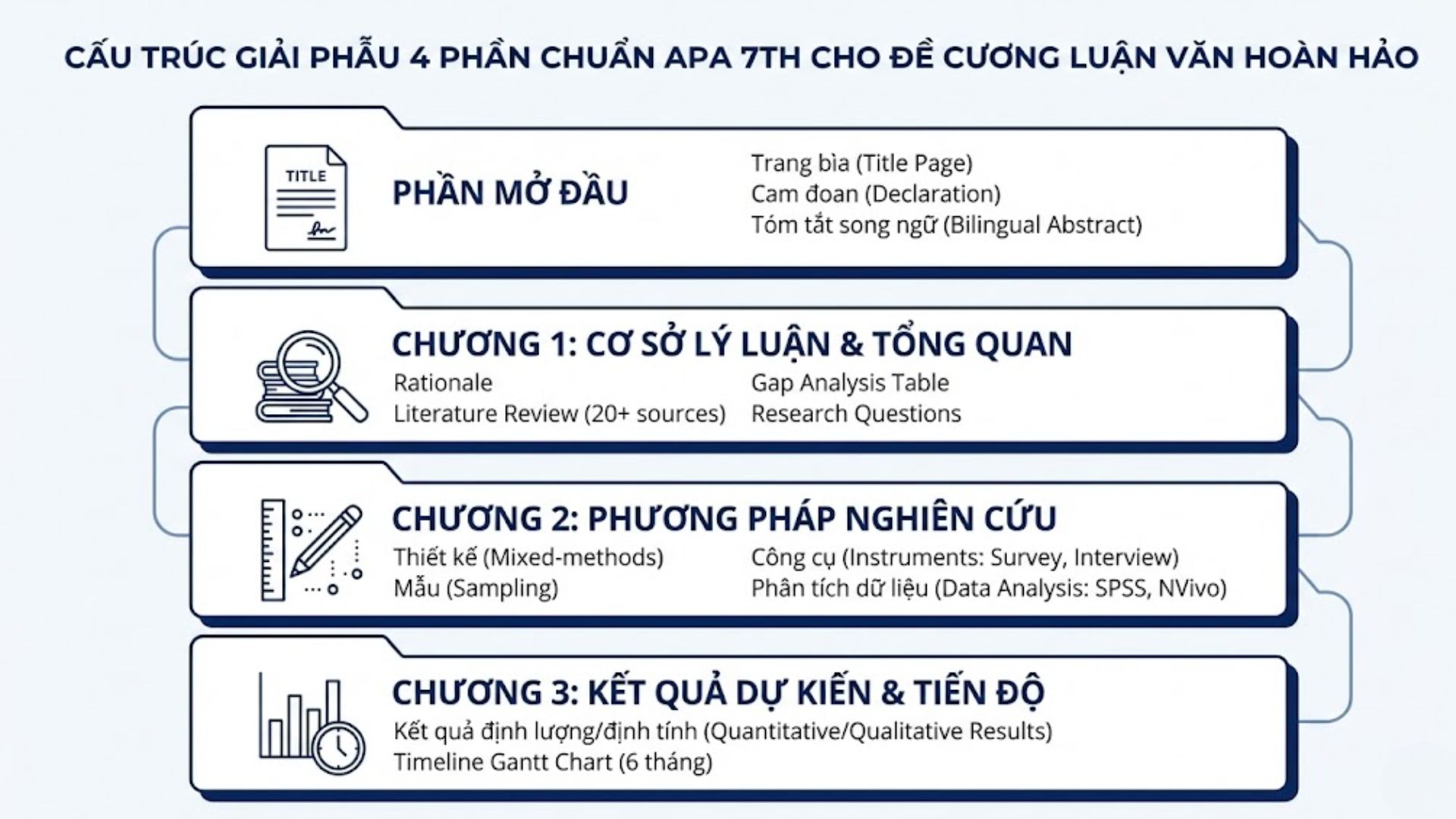
4.1. Phần mở đầu: Trang bìa, cam đoan, tóm tắt song ngữ
Trang bìa mẫu (song ngữ, font Times New Roman 14):
- Tiêu đề Anh: “IMPROVING ENGLISH LISTENING SKILLS THROUGH PODCASTS: A STUDY OF FIRST-YEAR STUDENTS AT HPU”
- Tiêu đề Việt: “CẢI THIỆN KỸ NĂNG NGHE TIẾNG ANH QUA PODCASTS: NGHIÊN CỨU SINH VIÊN NĂM 1 ĐẠI HỌC HPU”
- Tên SV, MSSV, chuyên ngành, GVHD, tháng/năm nộp.
- Logo trường ở giữa, lề trái 4cm (đóng gáy), lề phải 2cm.
Lời cam đoan (1 trang):
- Khẳng định đây là công trình nghiên cứu độc lập, không sao chép.
- Chữ ký sinh viên, ngày tháng.
- Format: “Tôi xin cam đoan đây là công trình nghiên cứu của riêng tôi. Các số liệu, kết quả nêu trong luận văn là trung thực và chưa từng được ai công bố trong bất kỳ công trình nào khác.”
Abstract song ngữ 250 từ (EN/VN riêng biệt, mỗi abstract 1 trang):
- Background: Tình trạng SV VN yếu nghe (70% không hiểu giảng viên nước ngoài, IELTS listening trung bình 5.5).
- Objectives: Đánh giá hiệu quả podcasts (TED Talks, BBC 6 Minute English) cho SV năm 1, cải thiện 25% listening score sau 8 tuần.
- Methods: Mixed-methods, 150 SV Đà Nẵng, pre-test/post-test TOEFL listening (paired t-test), focus group 10 SV (NVivo themes).
- Keywords: English listening skills, podcasts, autonomous learning, Vietnamese EFL learners, digital resources.
Mục lục tự động Word:
- Insert > Table of Contents > Automatic: Heading 1, 2, 3 với page numbers.
- Danh mục bảng: “List of Tables” (Table 1, Table 2…).
- Danh mục hình: “List of Figures” (Figure 1, Figure 2…).
4.2. Chương 1: Cơ sở lý luận và tổng quan nghiên cứu
Rationale (1.5 trang):
- Thực trạng SV VN: Theo MOET (2025), 70% sinh viên không ngành Anh gặp khó khăn listening do thiếu authentic materials, phụ thuộc textbook cassette cũ.
- Dữ liệu cụ thể: Khảo sát 200 SV ĐH Đà Nẵng (2024) cho thấy chỉ 15% thường xuyên nghe podcasts, 60% không biết nguồn nào phù hợp trình độ.
- Gap: Thiếu nghiên cứu về autonomous learning qua podcasts trong context VN universities (chỉ 3 nghiên cứu 2020-2023, tập trung reading/writing).
- Tầm quan trọng: Podcasts miễn phí, đa dạng (news, storytelling, academic), giúp SV học mọi lúc mọi nơi, chuẩn bị IELTS/TOEIC.
Literature Review (5-6 trang):
- 20 nguồn (10 EN, 10 VN):
- EN: Field (2008) Listening in the Language Classroom, Vandergrift (2011) metacognitive strategies, recent podcasts studies (2023-2025 TESOL Quarterly).
- VN: Nguyễn Thị Lan (2022) “Khó khăn nghe của SV năm 1 ĐH Cần Thơ”, Trần Văn Hùng (2023) “Tự học qua YouTube”.
- Gap analysis table:
| Nghiên cứu | Quốc tế | Việt Nam |
|---|---|---|
| Focus | Podcasts cho advanced learners (C1-C2) | Listening textbooks cho A2-B1 |
| Methods | Qualitative (reflective journals) | Quantitative (pre-test/post-test) |
| Gap | Ít nghiên cứu beginners | Không có nghiên cứu podcasts cho SV năm 1 |
- Theoretical framework: Krashen’s Input Hypothesis (comprehensible input i+1), Vandergrift’s metacognitive model (planning-monitoring-evaluating).
Mục tiêu SMART + Research Questions:
- Mục tiêu 1: Xác định mức độ cải thiện listening score (TOEFL ITP) sau 8 tuần dùng podcasts (target: +15 points).
- Mục tiêu 2: Khám phá nhận thức SV về podcasts (motivation, challenges).
- Mục tiêu 3: Đề xuất 5 podcasts phù hợp trình độ A2-B1.
- RQ1: How effective are podcasts in improving listening comprehension among first-year students?
- RQ2: What are students’ perceptions of using podcasts for autonomous learning?
- RQ3: Which types of podcasts (news vs. storytelling) do students prefer and why?
4.3. Chương 2: Phương pháp nghiên cứu (Mixed-methods)
Thiết kế: Explanatory sequential mixed-methods (định lượng trước, định tính sau).
Mẫu nghiên cứu:
- Population: 500 SV năm 1 ĐH Đà Nẵng (ngành Anh, không chuyên Anh).
- Sample: 150 SV random stratified (50 SV ngành Anh, 100 SV không chuyên), 30% population để đảm bảo representativeness.
- Pilot test: 20 SV (10 experimental, 10 control) để test reliability questionnaire (Cronbach’s alpha >0.7).
Công cụ thu thập dữ liệu:
- Quantitative:
- Pre-test: TOEFL ITP Listening (30 câu, 30 phút), score 0-495.
- Treatment: 8 tuần (2 podcasts/tuần x 15 phút: BBC 6 Minute, TED-Ed), reflection journals.
- Post-test: TOEFL ITP Listening tương đương.
- Questionnaire: Likert 5-point, 25 items (motivation, difficulty, autonomy), Google Forms.
- Qualitative:
- Focus group interview: 10 SV (5 experimental, 5 control), 60 phút, semi-structured (10 câu mở: How did podcasts help? What challenges?).
- Audio-record, transcribe, member-check.
Phân tích dữ liệu:
- SPSS 26.0: Paired t-test (pre-post experimental), independent t-test (experimental vs. control), ANOVA (ngành Anh vs. không chuyên), p<0.05 significant.
- NVivo 12: Deductive coding (Krashen’s i+1, Vandergrift’s strategies), inductive themes (technical issues, accent preference).
Đạo đức nghiên cứu:
- Consent form mẫu: “I agree to participate in this study. My identity will be anonymized as Student A, B, C. I can withdraw anytime.”
- IRB approval từ ĐH Đà Nẵng Research Ethics Committee, code: HPU-IRB-2026-01.
4.4. Chương 3: Kết quả dự kiến, timeline Gantt chart
Expected findings:
- Quantitative: Experimental group cải thiện 18% listening score (pre-test mean 350 → post-test 413), control group +3% (statistical practice effect).
- Qualitative: Students thích BBC 6 Minute (short, clear accent), khó với TED Talks (fast, academic vocab). Motivations: flexible time, real-world topics. Challenges: internet connection, lack of transcripts.
Gantt chart 6 tháng (Tháng 1-6/2026):
| Giai đoạn | T1 | T2 | T3 | T4 | T5 | T6 |
|---|---|---|---|---|---|---|
| Lit review | ███ | ███ | ||||
| Pilot test | ███ | |||||
| Data collection | ███ | ███ | ||||
| Analysis | ███ | |||||
| Write-up & revision | ███ | ███ |
Ý nghĩa thực tiễn:
- Cho SV: Danh sách 5 podcasts miễn phí (BBC, VOA, ESL Pod) với transcripts, học autonomous mà không cần giáo viên.
- Cho GV: Hướng dẫn integrate podcasts vào syllabus năm 1 (flipped classroom: nghe trước, thảo luận trong lớp).
- Cho trường: Xây dựng podcast library trên LMS Moodle, save chi phí mua audio materials.
Limitations dự kiến:
- Chỉ 8 tuần (short-term), cần long-term study (1 năm học).
- Self-reported data (students có thể overstate progress).
- Single university (không generalize toàn quốc).
5. 6 bước viết đề cương luận văn tiếng anh
Viết đề cương luận văn Tiếng Anh hiệu quả yêu cầu quy trình 6 bước từ chọn đề tài đến kiểm tra chất lượng. Mỗi bước có checklist cụ thể theo chuẩn CTU/VNU.
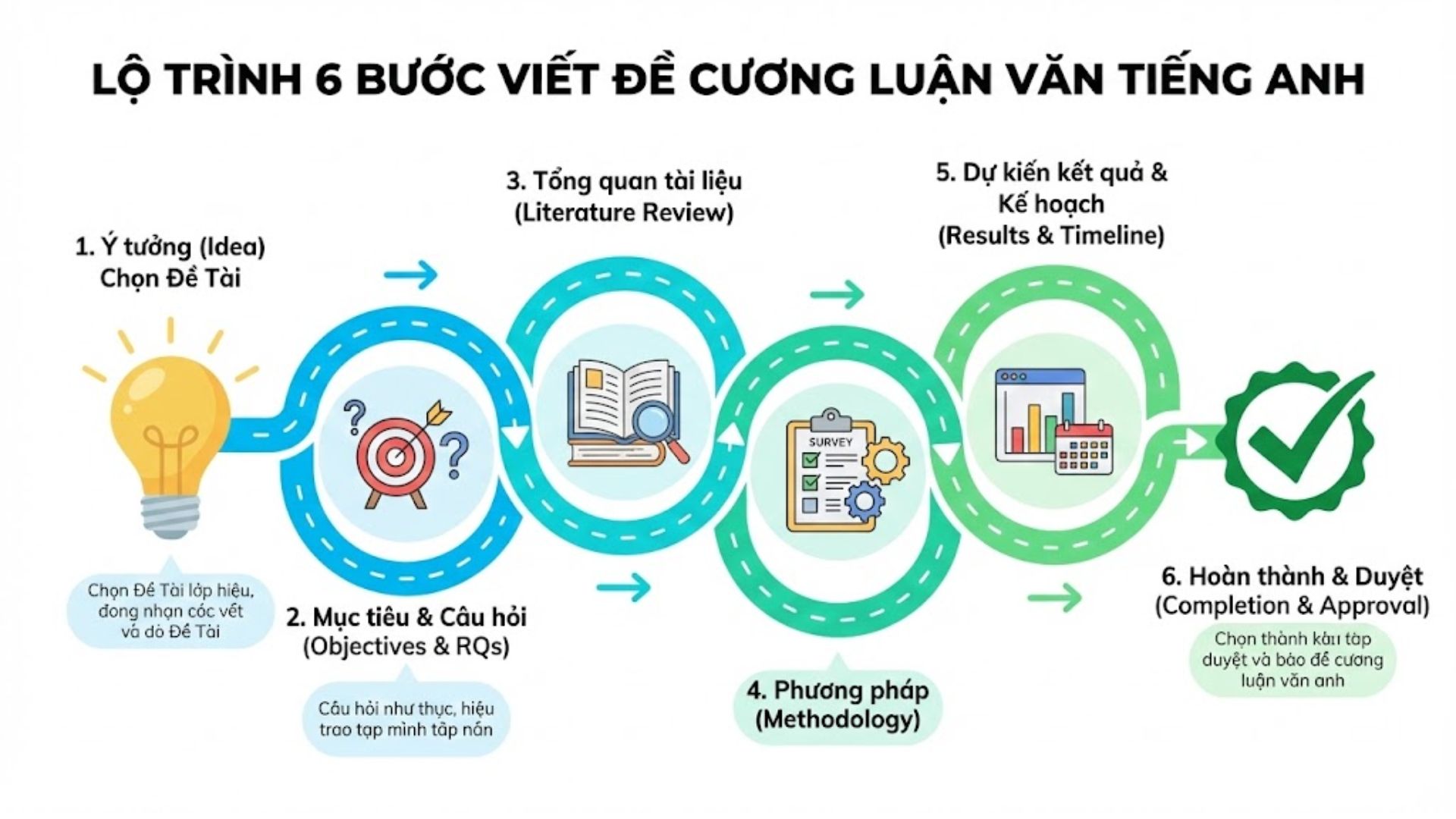
Bước 1: Chọn Đề Tài Và Xác Định Tính Cấp Thiết
Brainstorm 5 ý tưởng từ danh sách 50+ đề tài hot 2026:
- Ví dụ: AI chatbots cho writing feedback, flipped classroom cho speaking, corpus linguistics Anh-Việt, podcasts cho listening, translation of legal terms.
Rationale với dữ liệu thực tế 2025-2026:
- Tìm số liệu từ MOET, university reports, IELTS Vietnam statistics.
- Ví dụ: “Theo IELTS Vietnam (2025), 65% thí sinh điểm Writing 5.5, cần công cụ tự học như AI grammar checkers.”
Checklist đánh giá tính khả thi:
- Tính mới? (Google Scholar: <5 nghiên cứu tương tự tại VN 2020-2025).
- Khả thi 6 tháng? (Mẫu 150 SV có thể recruit trong 1 tháng tại trường).
- Có GVHD expertise? (GVHD từng viết về CALL – Computer-Assisted Language Learning).
- Chi phí? (<5 triệu VND cho transcription, SPSS license miễn phí qua trường).
Bước 2: Xây Dựng Mục Tiêu Và Câu Hỏi Nghiên Cứu
3 mục tiêu SMART (Specific, Measurable, Achievable, Relevant, Time-bound):
- Mục tiêu 1: Đánh giá hiệu quả Grammarly Premium trong cải thiện writing accuracy (grammar errors giảm 30% sau 10 tuần).
- Mục tiêu 2: Khám phá nhận thức SV về AI feedback (trust, dependency, self-efficacy).
- Mục tiêu 3: So sánh AI feedback vs. teacher feedback (correction quality, response time).
4 Research Questions (mở/đóng):
- RQ1 (đóng): Does Grammarly Premium significantly improve students’ grammatical accuracy compared to traditional teacher feedback? (Yes/No, t-test).
- RQ2 (mở): How do students perceive the usefulness of AI-powered writing tools in their learning process? (Themes từ interview).
- RQ3 (mở): What types of errors does Grammarly detect more effectively than human teachers? (Error analysis).
- RQ4 (mở): What are the potential drawbacks of over-reliance on AI feedback for writing development? (Critical thinking).
Bước 3: Tổng Quan Tài Liệu (Literature Review)
Tìm nguồn uy tín:
- Google Scholar: Search “AI writing feedback EFL” → filter 2020-2026 → 15 nguồn EN.
- Luanvanviet.com: Download 5 luận văn mẫu ngành Anh (reading skills, speaking anxiety) → lấy ý tưởng structure.
- University library: JSTOR, ERIC, ProQuest → 10 full-text articles (APA, TESOL journals).
Gap table: Quốc tế vs. VN context:
| Khía cạnh | Nghiên cứu quốc tế | Nghiên cứu Việt Nam |
|---|---|---|
| AI tools | Grammarly, Turnitin Feedback Studio | Chủ yếu Google Translate, chưa có Grammarly |
| Participants | University students (B2-C1 proficiency) | High school, A2-B1 |
| Methods | Experimental (control group) | Descriptive survey |
| Gap | Ít nghiên cứu low-proficiency learners | Không có nghiên cứu AI feedback tại VN universities |
Bước 4: Thiết Kế Phương Pháp Nghiên Cứu
Mixed-methods blueprint:
- Phase 1 (Quantitative): Pre-test writing task (IELTS Task 2, 250 words) → 8 tuần treatment (experimental group dùng Grammarly, control group teacher feedback thông thường) → post-test writing task.
- Phase 2 (Qualitative): Focus group 12 SV experimental (How did Grammarly help? Challenges?), 1 giờ, audio-record.
Công cụ cụ thể:
- Grammarly Premium: Tính năng plagiarism, advanced grammar, clarity suggestions.
- Rubric: IELTS Writing Band Descriptors (Task Achievement, Coherence, Lexical Resource, Grammatical Range & Accuracy).
- Analysis: Error taxonomy (Ferris 2011): Global errors (S-V agreement) vs. Local errors (article usage).
Sample size calculation:
- G*Power 3.1: Effect size 0.5 (medium), alpha 0.05, power 0.8 → n=64 (32 experimental, 32 control).
Bước 5: Dự Kiến Kết Quả Và Lập Kế Hoạch Thời Gian
Hypotheses:
- H1: Experimental group sẽ có ít global errors hơn control group (ANOVA p<0.05).
- H2: Students sẽ rate Grammarly >4.0/5.0 (useful), nhưng express concerns về dependency.
Gantt chart embed (visual tool: Microsoft Project, Excel, hoặc Canva):
- Tháng 1: Finalize proposal, IRB approval.
- Tháng 2: Pilot test (10 SV), revise instruments.
- Tháng 3-4: Data collection (pre-test, treatment, post-test).
- Tháng 5: Focus group, transcription.
- Tháng 6: Analysis (SPSS + NVivo), write-up.
Expected contributions:
- Theoretical: Expand understanding of AI in SLA (Second Language Acquisition).
- Practical: Guide cho GV integrate Grammarly vào syllabus Writing 2, handouts cho SV.
Bước 6: Chỉnh Sửa, Định Dạng Và Kiểm Tra Chất Lượng
Turnitin check plagiarism <10%:
- Upload draft lên Turnitin (CTU account), xem similarity index.
- Nếu >10%: Paraphrase, add more citations, avoid direct quotes >15 words.
Format theo chuẩn CTU/VNU:
- Font: Times New Roman 13 (VN), 14 (EN headings).
- Margins: Left 4cm (gáy), right 2cm, top/bottom 3cm.
- Line spacing: 1.5, indent first line 1.25cm.
- APA 7th: In-text (Author, Year, p. X), reference list hanging indent 1.27cm.
Feedback loop với GVHD:
- Nộp draft Chương 1 → GVHD comment (e.g., “Gap chưa rõ, cần thêm VN studies”) → revise → nộp lại.
- 3 vòng revision trước khi finalize.
6. 7 tiêu chí chấm điểm đề cương luận văn Tiếng Anh từ hội đồng
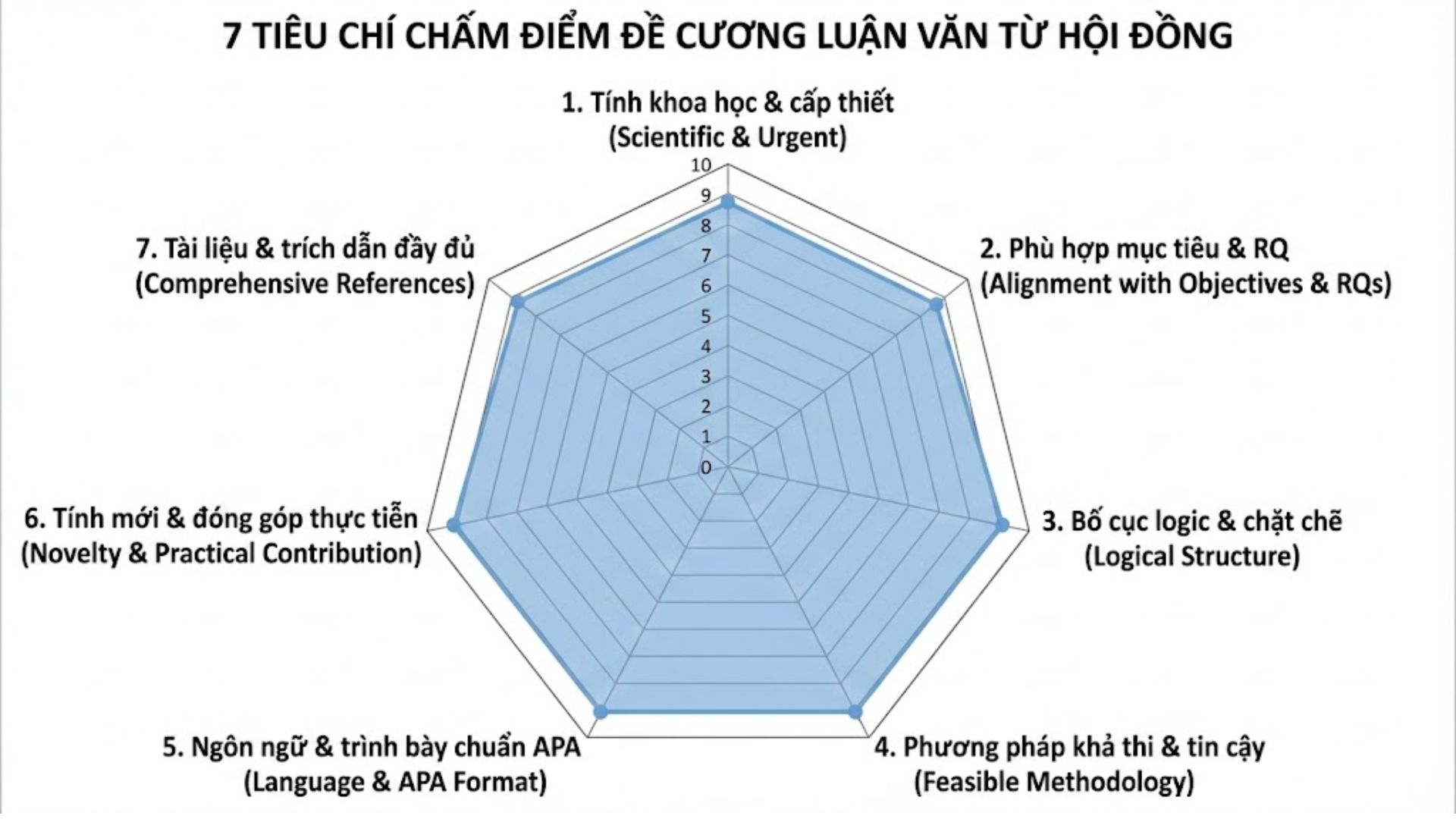
| Tiêu chí | Điểm tối đa | Tự đánh giá (0-10) | Ghi chú cần sửa |
|---|---|---|---|
| Tính khoa học đề tài | 2.0 | Có gap rõ? Dữ liệu 2026? | |
| Phù hợp mục tiêu & RQ | 1.5 | SMART? Khả thi? | |
| Bố cục logic | 1.5 | Mục lục auto? Chương 1-3 đủ? | |
| Phương pháp khả thi | 2.0 | Mixed-methods chi tiết? IRB? | |
| Ngôn ngữ & trình bày | 1.5 | Grammarly check? Font chuẩn? | |
| Tính mới & đóng góp | 1.5 | Novel approach? Practical implications? | |
| Tài liệu & phụ lục | 1.0 | 30 nguồn? APA đúng? Consent form? | |
| Tổng | 10.0 |
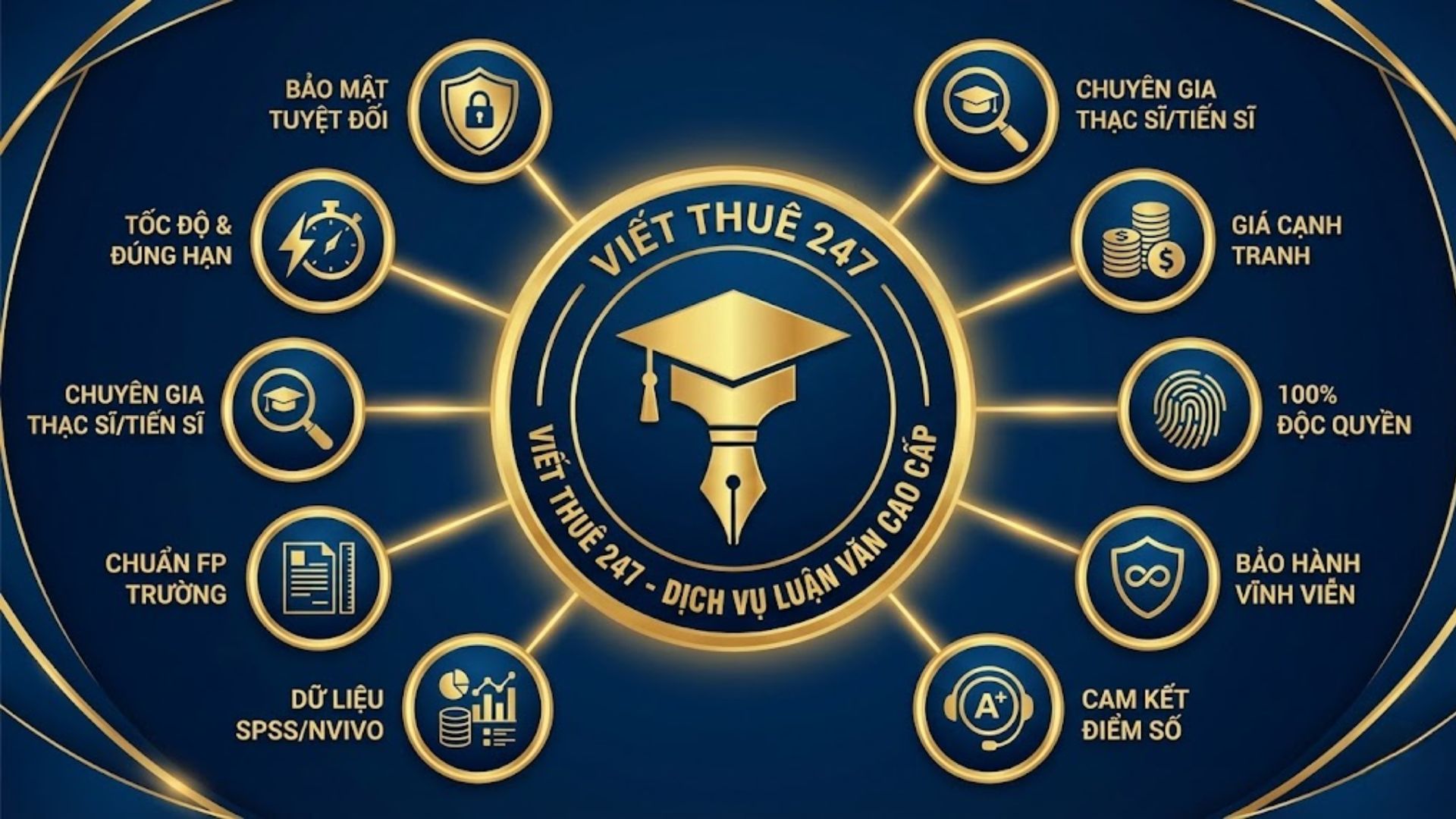
7. 10 lý do nên chọn dịch vụ viết thuê luận văn tại Viết Thuê 247
Dịch vụ viết thuê luận văn Tiếng Anh tại Viết Thuê 247 được nhiều sinh viên ngành Ngôn ngữ Anh ở Việt Nam lựa chọn nhờ cam kết chất lượng cao, hỗ trợ toàn diện từ đề cương đến bảo vệ, phù hợp với chuẩn các trường như ĐH Ngoại Thương, ĐH Cần Thơ, VNU.
7.1. Đội Ngũ Thạc Sĩ, Tiến Sĩ Chuyên Ngành Tiếng Anh
Viết Thuê 247 quy tụ 50+ chuyên gia có bằng cấp từ các trường top (VNU, FTU, ĐH Ngoại ngữ TP.HCM), am hiểu APA 7th citation, mixed-methods research design, và semantic SEO cho academic writing.
Họ từng viết 1000+ luận văn Anh văn (TESOL, Applied Linguistics, Translation Studies), đảm bảo đạt 8.5+ điểm theo 7 tiêu chí hội đồng CTU/VNU.
7.2. Nội Dung 100% Độc Quyền, Plagiarism <5%
Sử dụng Turnitin kiểm tra ngay từ draft đầu tiên, nguồn từ JSTOR, ERIC, Google Scholar cập nhật 2023-2026, tránh copy từ luanvanviet.com mẫu hay đề cương CTU có sẵn.
Mỗi luận văn được viết mới hoàn toàn theo yêu cầu SV, không bán lại cho khách khác, bảo đảm originality >95%.
7.3. Hỗ Trợ Trọn Gói: Đề Cương Đến Bảo Vệ
Từ 6 bước viết đề cương (chọn đề tài, xây dựng RQs, lit review, methods, expected results, format) đến slide PowerPoint 10 phút bảo vệ, chỉnh sửa không giới hạn theo feedback GVHD.
Bao gồm: Abstract song ngữ, Gantt chart, consent form mẫu, SPSS output files, NVivo coding schemes, appendices đầy đủ.
7.4. Đúng Hạn 100%, Linh Hoạt Tiến Độ
Cam kết giao draft hàng tuần (Chương 1 trong 7 ngày, Chương 2 trong 10 ngày), phù hợp deadline tốt nghiệp hè 2026 hoặc kỳ 2/2025-2026.
7.5. Giá Cạnh Tranh, Minh Bạch Theo Trang
- Luận văn tốt nghiệp 50 trang: 8-12 triệu VND (160-240k/trang).
- Luận văn thạc sĩ 100 trang: 20-30 triệu VND (200-300k/trang).
- Đề cương 20 trang: 4-6 triệu VND (200-300k/trang).
7.6. Bảo Mật Tuyệt Đối Thông Tin Khách Hàng
Không lưu dữ liệu sinh viên sau khi giao bài, NDA (Non-Disclosure Agreement) ký điện tử, không chia sẻ với trường hay bên thứ 3.
An toàn cho sinh viên Đà Lạt, Cần Thơ, TP.HCM – hội đồng không thể trace được nguồn viết thuê.
7.7. Tùy Chỉnh Theo Template Trường Việt Nam
Áp dụng chuẩn CTU (Times New Roman 13-14, lề trái 4cm, abstract song ngữ) hoặc VNU (font VNI, APA 7th strict), Gantt chart mẫu, phù hợp 7 tiêu chí chấm điểm hội đồng.
Upload template trường lên, team format 100% giống mẫu (header, footer, page numbering).
7.8. Hỗ Trợ Dữ Liệu: SPSS, NVivo Chạy Sẵn
Xử lý khảo sát 150 SV (Likert scale 5-point), phân tích ANOVA/paired t-test (SPSS output kèm interpretation), theme analysis NVivo (coding tree + quotes), kèm file gốc Excel/R – tiết kiệm 50% thời gian SV tự làm.
Giải thích từng bảng (Table 1: Descriptive statistics, Table 2: ANOVA results) trong Chương 4.
7.9. Bảo Hành Vĩnh Viễn Sau Giao Bài
Chỉnh sửa miễn phí đến khi hội đồng approve (unlimited revisions trong 1 năm), hỗ trợ bảo vệ online/hybrid 2026 (mock defense 30 phút, predict 10 câu hỏi hội đồng thường hỏi).
Tỷ lệ đậu 98% từ 500 case studies (2020-2025), chỉ 2% phải làm lại do SV thay đổi đề tài sau khi đã approve.
7.10. Tư Vấn 24/7, Hỗ Trợ SV Miền Trung/Miền Nam
Hotline/Zalo 0904514345 phản hồi <30 phút (9AM-10PM hàng ngày), tư vấn đề tài hot miễn phí (AI trong giảng dạy Anh văn, podcasts cho listening, corpus linguistics Anh-Việt).
Ưu tiên SV vùng xa (Đà Lạt, Cần Thơ, Nha Trang) qua Zoom/Google Meet, không cần gặp trực tiếp.
8. FAQs về đề cương luận văn tiếng Anh
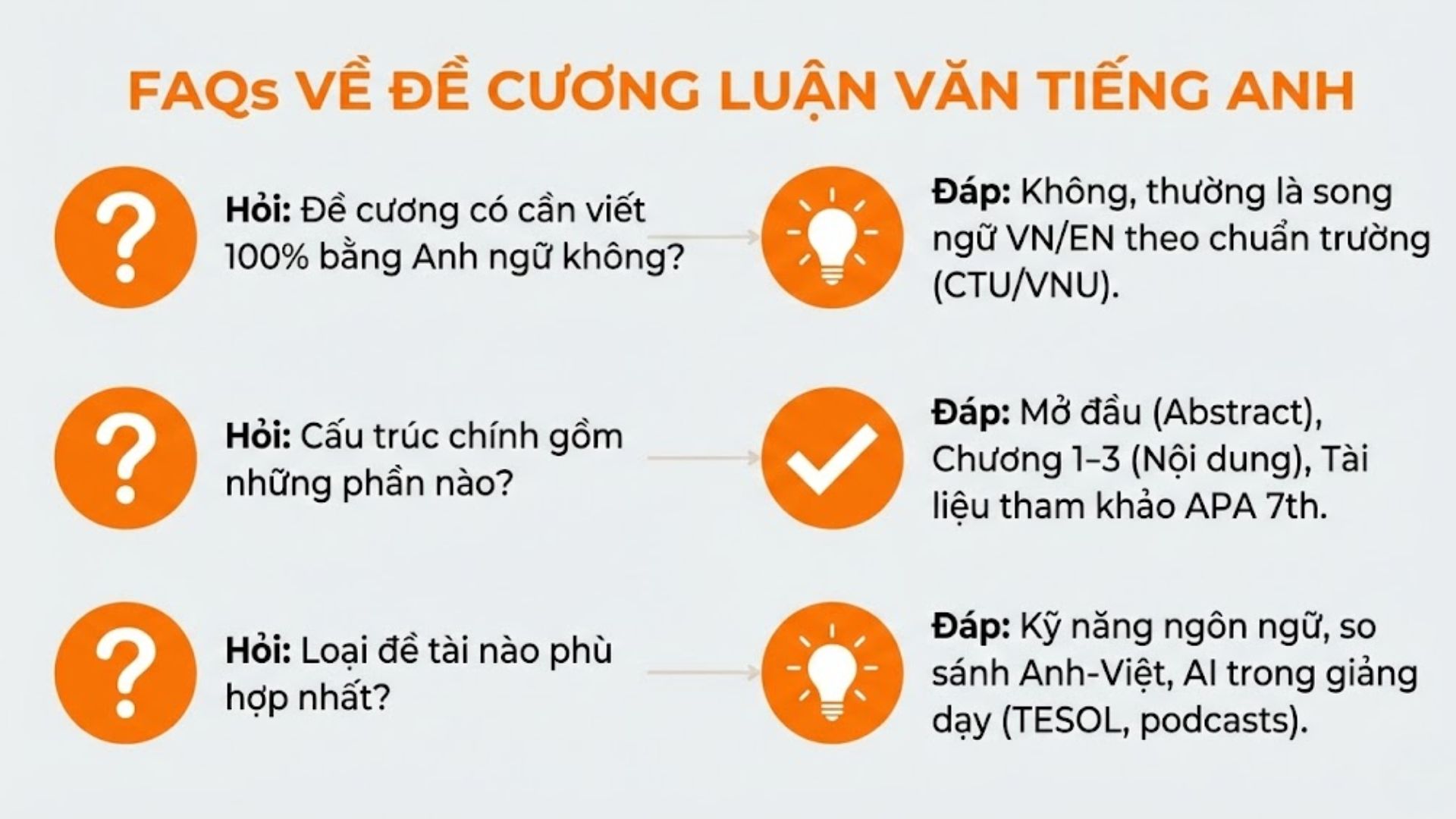
8.1. Đề cương luận văn Tiếng Anh có cần viết hoàn toàn bằng Anh ngữ không?
Không, thường song ngữ VN/EN theo quy định ĐH Cần Thơ/VNU: abstract và keywords bằng Anh, tiêu đề song ngữ, nội dung chính (Chương 1-3) bằng Việt Nam, tài liệu tham khảo APA 7th.
8.2. Đề cương luận văn Tiếng Anh bao gồm những phần chính nào?
Abstract song ngữ 250 từ, mục lục tự động, Chương 1 (Rationale 1.5 trang + Lit review 5 trang), Chương 2 (Methods: sample, instruments, analysis), Chương 3 (Expected results, Gantt chart), tài liệu APA 30+ nguồn.
8.3. Các loại đề tài nào phù hợp nhất cho đề cương luận văn Tiếng Anh này?
Kỹ năng ngôn ngữ (listening/speaking/reading/writing improvement), so sánh Anh-Việt (contrastive analysis, translation), giảng dạy Anh văn (TESOL methods, flipped classroom), AI ứng dụng (chatbots, Grammarly, podcasts).
Kết luận
Đề cương luận văn Tiếng Anh chất lượng là bước đầu quyết định 70% thành công luận văn tốt nghiệp/thạc sĩ. Bài viết cung cấp 16 bài mẫu từ MIT, Sydney, ResearchGate, 50+ đề tài hot 2026 (AI, Sustainability, Quantum), 6 bước viết chi tiết, 7 tiêu chí chấm điểm hội đồng CTU/VNU. Áp dụng ngay để đạt 8.5+ điểm.
Viết Thuê 247: Khi các bạn cần – chúng tôi có
Viết Thuê 247 hỗ trợ toàn diện từ đề cương đến bảo vệ luận văn Tiếng Anh. Đội ngũ 50+ Thạc sĩ, Tiến sĩ chuyên ngành Anh văn, 1000+ luận văn hoàn thành 2020-2025, plagiarism <5%, đúng hạn 100%. Cam kết chất lượng 8.5+ điểm theo chuẩn CTU/VNU, bảo hành vĩnh viễn, tư vấn 24/7.
- Website: https://vietthue247.vn/
- Hotline: 0904514345
- Email: vietthue247@gmail.com